The real power comes from combining these endpoints to create voice experiences that drive customer loyalty and operational scale.
Buyers comparing usage-based voice AI vendors more broadly should also look at this Bolna AI pricing breakdown, which shows how a similar processing-plus-telephony-plus-platform-fee cost stack plays out at a different vendor in the same India market.
The endpoints are only half the equation. It’s also worth understanding the underlying AI models. Your choice of model, for example selecting one from the expressive v3 series, directly impacts final audio quality and emotional depth.
Mastering Authentication and Enterprise Security
For any enterprise-level application, particularly in regulated sectors like BFSI and EdTech, security is foundational, not a feature. Every interaction with the ElevenLabs API must be completely secure, and that starts with solid authentication.
Every API request needs to be authenticated with your unique API key, passed in the header as xi-api-key. This key identifies your application and authorises access to your subscribed services. Its compromise represents a significant business risk.
How to Get Your ElevenLabs API Key
To get an ElevenLabs API key, sign in at elevenlabs.io, open your Workspace settings, and select the API Keys tab. Click Create API Key, name it for the integration it will serve, and copy the string immediately, since ElevenLabs shows it only once. Store it as an environment variable, never in client-side code or a public repository.
Secure API Key Management
Environment variables: the most common method, storing the key on your server and keeping it out of source code entirely.
Secret management tools: for enterprise-grade security, dedicated services like AWS Secrets Manager, Azure Key Vault, or HashiCorp Vault provide centralised control, automated key rotation, and audit trails.
Securing API interactions is one piece of a larger compliance puzzle. This typically means implementing strong encryption for data in transit and at rest, a practice that often aligns with SOC 2 encryption requirements.
Here’s a practical example showing how to pull your API key from an environment variable in Python, a best practice for any production environment.
import os import requests # Retrieve the API key from environment variables for security XI_API_KEY = os.getenv(“ELEVENLABS_API_KEY”) if not XI_API_KEY: raise ValueError(“API Key not found. Please set the ELEVENLABS_API_KEY environment variable.”) headers = { “Accept”: “application/json”, “xi-api-key”: XI_API_KEY } # Make a request to an ElevenLabs endpoint try: response = requests.get(“https://api.elevenlabs.io/v1/voices”, headers=headers) response.raise_for_status() print(response.text) except requests.exceptions.RequestException as e: print(f”An error occurred: {e}”)
Data Residency and Compliance for India
For enterprises operating in India, data residency is a key consideration for both regulatory compliance and application performance. The ElevenLabs API gives you the option to use India-specific data centres, ensuring voice data is processed and stored within the country’s borders.
This helps meet local data protection mandates while also delivering a performance win, since it reduces latency for real-time use cases. You can explore more on global enterprise compliance for voice AI.
Generating Lifelike Audio with the Text-to-Speech API
The Text-to-Speech (TTS) endpoint is the core of any voice AI strategy. This is where raw text becomes a valuable brand asset, an empathetic customer service agent, a clear KYC prompt, or a persuasive sales pitch.
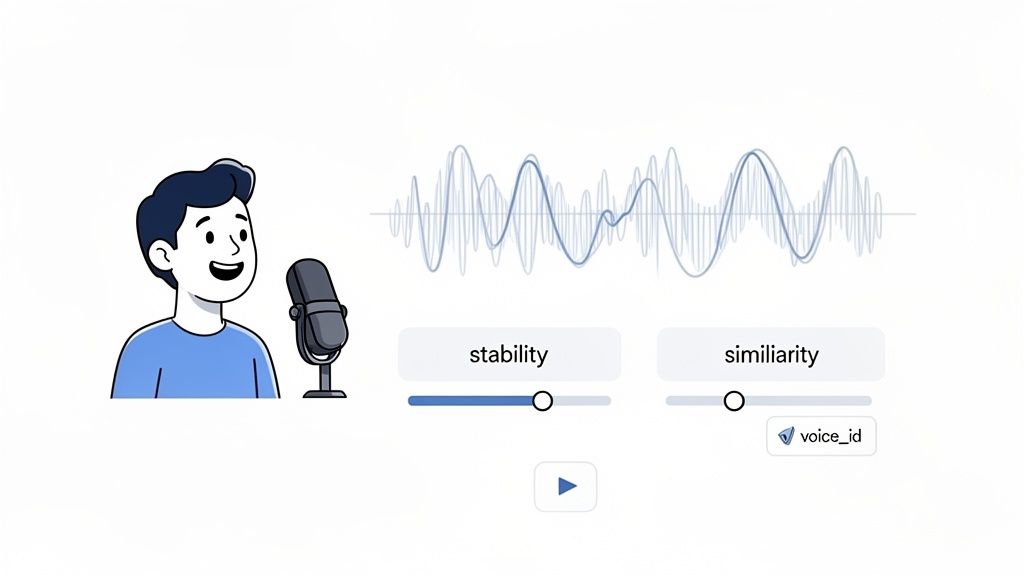
At its simplest, using the ElevenLabs API for TTS involves sending a text payload and a voice_id to the endpoint. The voice_id points to the specific pre-made or custom-cloned voice you want to use, while text holds the script. The real control over how natural the delivery sounds comes from the parameters that fine-tune it.
Fine-Tuning Voice Performance
stability: governs how dynamic or monotonic the voice sounds. A lower value, around 0.0 to 0.3, creates more expressive and varied speech for engaging presales calls. A higher value, 0.7 to 1.0, produces a more consistent, stable delivery for formal scenarios like compliance-heavy KYC prompts.
similarity_boost: fine-tunes how closely generated audio matches the original source voice. Pushing it higher, into the 0.75 to 1.0 range, keeps the voice true to its source, which matters for a consistent brand persona across thousands of calls.
Getting these settings right is what separates an AI that sounds scripted from one that can hold a natural, multi-minute conversation.
Choosing the Right Model for the Job
Your choice of model_id has a major impact on audio quality and capability. The eleven_multilingual_v2 model works well for a diverse customer base in India, with strong support for languages like Hindi alongside English. The eleven_turbo_v2 and v3 models introduce dialogue mode and better emotional control, generating realistic multi-speaker conversations and handling interruptions and tonal shifts based on context. You can learn more about how generative AI is expanding beyond voice by exploring ElevenLabs’ text-to-sound-effects tool.
Handling Audio Responses
You need to decide how you want to receive generated audio: streaming or non-streaming. For any interactive application like a live AI call agent, streaming is non-negotiable, since it lets audio play back as it’s being generated, slashing latency and enabling a real-time conversational flow.
For non-interactive tasks, such as generating audio for marketing content or voicemails, a standard non-streaming request that returns the full audio file is usually more efficient.
Creating Unique Brand Voices with Voice Cloning
A brand’s voice is more than just a sound, it’s a core part of its identity, building trust and familiarity with every customer interaction. Moving past generic, off-the-shelf voices means working with the Voice Cloning and Voice Design endpoints to craft a custom voice that belongs exclusively to your brand.
Instant vs Professional Voice Cloning
Instant Voice Cloning (IVC): the fast option for quick tests. All you need is one to five minutes of clean audio with no background noise, producing a good clone suited to internal demos and proof-of-concept work.
Professional Voice Cloning (PVC): the production-grade option, requiring at least 30 minutes of high-quality recordings, processed directly by ElevenLabs to create a flawless, artifact-free clone with far superior clarity and emotional depth.
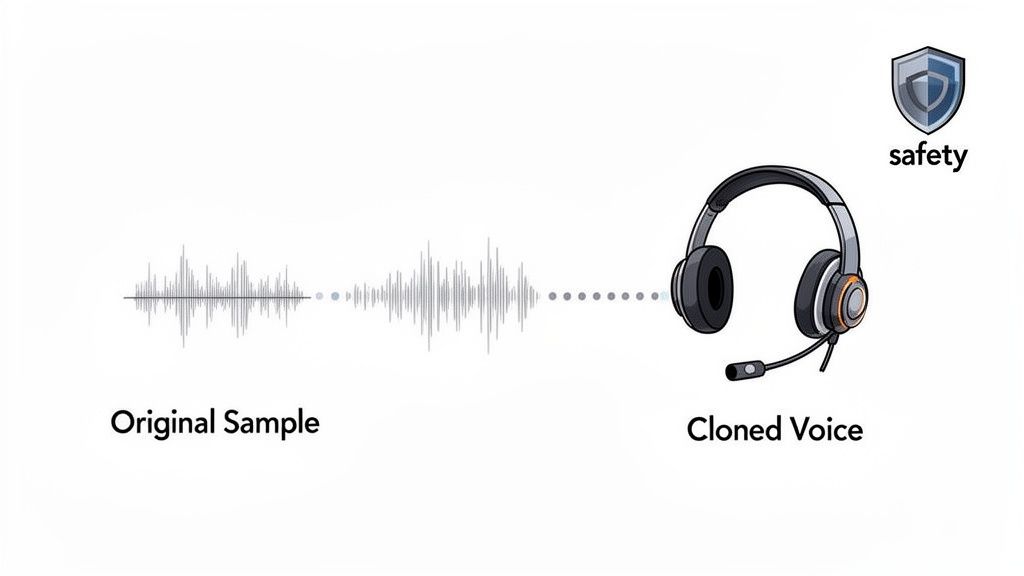
Voice cloning carries a real ethical dimension. ElevenLabs has built-in safeguards, including an AI Speech Classifier for detecting generated audio, and requires audio verification to confirm you have explicit permission to clone a voice.
How to Add and Use a Cloned Voice
Adding a new voice through the API is a two-step process. You first create a placeholder for the voice and upload audio samples to it, then use the voice_id you get back to generate speech.
The API responds with a new voice_id for the newly created voice, which you can then use directly in a TTS request.
curl -X ‘POST’ \ ‘https://api.elevenlabs.io/v1/text-to-speech/YOUR_VOICE_ID’ \ –header ‘accept: audio/mpeg’ \ –header ‘xi-api-key: YOUR_API_KEY’ \ –header ‘Content-Type: application/json’ \ -d ‘{ “text”: “Welcome. How can I assist you with your property search today?”, “model_id”: “eleven_multilingual_v2” }’ \ –output brand_voice_output.mp3
This simple technical process unlocks real strategic value. A real estate firm, for example, could clone the voice of their best agent and use it across thousands of automated lead qualification calls, scaling the impact of their most trusted voice without increasing headcount.
Practical Integration Use Cases for Enterprises
The real test of the ElevenLabs API isn’t in its documentation, it’s in how it solves real business problems. This section moves beyond theory into concrete integration patterns for key industries in India.
Real Estate: AI Agent for Lead Qualification
An AI agent handles first-touch property discovery calls, pre-qualifies potential buyers, and can schedule site visits on the spot, freeing human agents to focus on high-intent, sales-ready leads.
The agent introduces itself, asks qualifying questions such as configuration preference, and offers to book a site visit by checking an integrated calendar. This approach has been shown to lift lead-to-booking rates from a typical 2% to over 8%. A professionally cloned voice with a moderate stability setting around 0.4 keeps the tone conversational, while the eleven_multilingual_v2 model handles both English and regional languages.
EdTech: AI for Student Counselling
An automated counselling bot provides instant, 24/7 answers to questions about courses, eligibility, and fees, nurturing leads around the clock. If a query is too complex, it transfers the call to a human counsellor with full context.
This can increase application completion rates meaningfully by reducing drop-off. A higher stability setting around 0.7 ensures every interaction is consistently clear and reassuring, which matters when discussing someone’s educational future.
BFSI: Secure KYC Verification
An AI agent securely walks customers through the Know Your Customer process, reading out instructions, confirming personal details, and logging the entire interaction for auditing.
Automating this can reduce average KYC onboarding time from around 15 minutes to under 5, while improving accuracy and lowering operational costs. The eleven_monolingual_v1 model with a high stability setting of 0.75 or above creates the formal, no-nonsense delivery needed for official procedures.
API Parameters for Industry-Specific Use Cases
Use Case (Industry)
Recommended model_id
Suggested stability Setting
Goal
Real Estate
eleven_multilingual_v2
0.40 – 0.60
Conversational and engaging lead qualification.
EdTech
eleven_multilingual_v2
0.65 – 0.75
Empathetic, patient, and clear student support.
BFSI
eleven_monolingual_v1
0.75 – 0.90
Authoritative and precise for compliance prompts.
E-commerce
eleven_turbo_v2
0.50 – 0.65
Friendly and efficient for order confirmations.
These settings are a great starting point. As you build, you can fine-tune them further to perfectly match your brand’s unique voice and achieve the specific outcomes you’re aiming for.
Optimising Costs and Scaling Your Implementation
The challenge for any VP or Director is scaling voice AI initiatives without letting operational costs spiral. Getting this right starts with understanding the ElevenLabs API pricing model, which is based on character usage, every character sent to the API for generation counts against your monthly quota. Different subscription tiers provide different character allowances and unlock features like Professional Voice Cloning.
Strategic Cost Optimisation
Implement caching: frequently used audio, like standard welcome greetings or compliance prompts, should be generated once and stored locally, which can meaningfully cut character consumption in a busy call centre.
Select efficient models: a simpler, more cost-effective model is often perfectly fine for basic notifications or IVR prompts, reserving the most advanced models for where they add real value.
Monitor usage proactively: keeping a close eye on character consumption and setting up alerts helps catch unusual spikes before they become a financial problem.
Your application must handle API rate limits gracefully. When you get an HTTP 429 error, don’t just retry immediately, implement an exponential backoff strategy to prevent service interruptions during peak traffic.
Fuelling Innovation in the Indian Ecosystem
ElevenLabs is actively invested in building the developer community in India through a global grants programme that has supported over 1,000 Indian startups, with more than 500 given free API access. You can read more about ElevenLabs’ strategic focus on India’s growth.
Troubleshooting Errors and Optimising Latency
When an application goes into production, it needs to be both resilient and responsive. For a live AI agent, every millisecond matters, and a single unexpected error can derail the experience.
Understanding Common API Errors
401 Unauthorized: your xi-api-key is either missing or invalid, a signal your authentication credentials aren’t being sent correctly.
422 Unprocessable Entity: a problem with the request data, such as an empty text field or a parameter like stability set outside its accepted range of 0.0 to 1.0.
429 Too Many Requests: you’ve hit your rate limit. Implement exponential backoff, waiting progressively longer between retries (1s, 2s, 4s, 8s) rather than retrying immediately.
Building in automated recovery for 429 errors is what separates a minor, self-correcting hiccup from a major service outage during peak hours.
Optimising for Real-Time Responsiveness
For interactive voice AI agents, low latency is everything. Even a delay of a few hundred milliseconds can make a conversation feel awkward. The API’s streaming endpoint is the most powerful tool for cutting this delay, letting your application start playing audio as soon as the first chunk arrives rather than waiting for the full file.
The model you choose also matters. Newer models like eleven_turbo_v2 are built for speed and offer lower latency than more complex counterparts. For any enterprise based in India, selecting the India-based data centre is a simple change that significantly reduces network round-trip time.
Conclusion
The ElevenLabs API gives teams the building blocks for genuinely natural voice AI, text-to-speech, voice cloning, and multilingual models, but the real value shows up once those endpoints are wired into a production workflow with proper authentication, caching, and error handling.
By integrating voice AI well, customer interactions shift from a cost centre to a revenue driver. DialNexa builds custom voice AI agents on this kind of infrastructure, worth testing on your own call volume before you commit to a longer build.
FAQs
1. How does the ElevenLabs API ensure cloned voice security?
The ElevenLabs API has several safety protocols built in to prevent misuse. A vocal verification step requires you to explicitly confirm you have permission to clone a voice, creating an audit trail. An AI Speech Classifier can also detect whether an audio clip was generated by the platform, adding a layer of accountability to protect a brand’s voice from being copied without consent.
2. What is the real-world latency for interactive calls?
In live, interactive calls, latency with the API’s streaming endpoints can get as low as 300 to 500 milliseconds, fast enough for a natural, back-and-forth conversation. Three factors influence that speed: model choice, since a lighter model like eleven_turbo_v2 is optimised for speed; data centre location, since India-based centres cut round-trip time for local users; and whether streaming is implemented correctly, which is usually the single biggest factor.
3. How can we calculate the ROI of integrating this API?
Focus on three areas: cost reduction, efficiency gains, and revenue growth. A simple framework is ((cost savings plus efficiency gains) minus integration cost) divided by integration cost. Compare the per-call cost of a human agent, factoring in salary and time, against the API’s character usage for the same call volume, and track how much time agents save on repetitive tasks like KYC prompts or lead qualification.
4. What is the difference between Text-to-Speech and Speech-to-Speech?
Text-to-Speech converts written text into spoken audio using a chosen voice, and is the right endpoint for prompts, notifications, and narration. Speech-to-Speech instead takes an existing audio recording and transforms its voice characteristics while preserving the original intonation and emotional delivery, which suits localising a campaign or keeping a consistent brand voice across different speakers.
5. Do I need Professional Voice Cloning, or is Instant Voice Cloning enough?
Instant Voice Cloning works well for internal demos, prototypes, and proof-of-concept work, since it only needs a few minutes of clean audio. Professional Voice Cloning requires at least 30 minutes of high-quality recordings but produces a clearer, more emotionally accurate clone, and is the standard choice for any serious, customer-facing AI agent.
Source attribution
“The Ultimate Eleven Labs API Guide for Enterprise AI” by Aditya Kamat, originally published on DialNexa on 10 Mar 2026.